
Learning to learn again, now that AI can do it for you
What I got wrong about learning, my comeback in continuous improvement, and the rules that fixed it

I love to learn. It always brought me so much joy: learning new things, becoming better at other things, mastering skills. It brings new perspectives, it can get you unstuck, it helps with creativity. And let's be honest, sometimes it's just nice to make a nifty gritty comment that makes everybody in the room think "wow".
But for the last few months I stopped learning new things, because it stopped making sense to me. And AI had something to do with that, because why learn new things when AI can summon everything for you.
Spoiler alert: well boi, was I wrong… Yes sorry, I know this sounds like a duh moment for most of you.
So for the last couple of months I felt lost. For those who do not know me, I work for myself as a fractional product manager, helping startups navigate the hard process of building and setting up strong development teams. And for months, I kept adjusting. My framing. My positioning. My direction. Something was always missing.
At some point, my work and my passion started to feel like a constraint.
This was a hard thing to admit to myself. When you're working for yourself, your wellbeing directly reflects on how the business is doing. So not a good signal. So I had to figure out what was going on.
Was I tired of the AI noise? Maybe. Did the market stop making sense to me? Maybe. Was the field changing too fast? No. Did I miss my passion for learning? YES!
Diving deep into topics again. Going hands on with something I just learned. Doing experiments and making mistakes.
I found out I had simply stopped learning, and with it, lost the thing I loved most about my work. What made it worse: in the age of AI there is a new way of learning, and I had not even learned about it yet.
So here we are: my first step back into continuous learning, on how to learn in the age of AI.

Why bother teaching yourself anything, now AI can just do it
If you already know you should keep learning and never doubted it, congrats, go ahead and skip this section. But if you have been quietly telling yourself that AI makes independent learning less necessary, this is for you.
So why bother, you say? Well, let's not overcomplicate it: AI is quite dumb, and it all depends on context. It does nothing less than predicting the next word. It is only a powerful tool if you know how to use it. A very old saying in IT is more relevant than ever: garbage in is garbage out. So it comes down to two things: what you put in, and what you do with what comes out.
Expertise: what you put in. Knowing your domain is what lets you feed AI the right context in the first place, the details that actually matter, the constraints it needs to know about, the framing that gets you a useful answer instead of a generic one. Without that, you are not directing AI, you are just hoping it guesses right.
Judgement: what comes out. It works on the way out instead of the way in. AI is built to sound like it's right, whether it is or not, because it is optimized to sound fluent, not to be correct. And deciding is what matters. That is exactly why a lot of people say judgement is the best thing to have right now.
Expertise and judgement do that job through four functions:
Catching the error a novice would miss. A wrong answer that sounds confident is invisible to someone who does not know enough to question it. Expertise is what makes the wrongness visible in the first place.
Asking the question that points AI somewhere useful. A vague prompt gets a generic answer. Knowing your domain is what lets you ask the specific, constrained question that actually gets AI working on your real problem instead of the average version of it.
Judging whether the output actually fits your workflow. AI does not know your codebase, your client, or your market. It only knows whether an answer sounds plausible in isolation. You are the one who has to judge whether it fits the actual context it needs to live in.
Telling good enough apart from genuinely good. This is the hardest one to fake. In anything creative or strategic, the gap between adequate and excellent is exactly where expertise shows up, and AI has no way to close that gap for you.
AI predicts the next word based on patterns in what it was trained on, it has a knowledge cutoff, and it does not browse the live web unless you turn that on. That is not a flaw you can patch by asking nicely, it is just the limitations of where we are.
Which is exactly why you sometimes have to distrust what comes out. Not because AI is lying to you, it cannot do that, but because it genuinely does not know what it does not know. It will answer a question past its cutoff with the same fluent confidence as one it actually knows.
Expertise and judgement help you navigate through this.
Continuous improvement and learning is what gives you resilience. It is also the one thing that compounds. Every skill you pick up now makes the next AI interaction sharper, and that stacking effect is what actually keeps you ahead.
And if you are not learning on a continuous basis, I highly recommend you start from today onward. Here is a guide to help you.
Old habits, new tools
Expertise and judgement are not grown overnight. You build both the same way people have always built them: by learning. Become an expert in a topic by learning about it. By just doing it.
The only thing that changed is the environment you can draw your knowledge from. You do not have to buy a book anymore, or hunt down the right source. The answer is always one prompt away.
The question is how you actually do it, in a world where AI can do most of the work for you if you let it.
You do it the way you always have: by doing it, through repetition, through getting things wrong until you stop getting them wrong. The only difference is that AI can help you understand it faster, cover more ground, and navigate it as you go.
Here are a few ways AI can help you learn:
Learn with AI, not around it. Learn AI fluency, a framework for how you work with AI. I will dive deeper into this later on.
Create a system that helps you learn. You do not become an expert by reading more, or by letting AI generate more. You become one by writing down what you decide and notice, so it stacks instead of evaporating. Let AI log this for you.
Explain it to AI. The moment you put something into words for someone else, you find out exactly where your own understanding is thin. This article is a version of that.
And here will be a payoff.
What all that expertise actually gives you is context, and context is the one thing AI does not have and never will. It knows a lot in general, it knows nothing about your client, your codebase, your market, your specific mess, until you tell it.
Combined with your expertise, you can feed it quality, no more garbage in. Quality in is quality out. You also become better at judgement: the more you know, the better you can tell when AI actually nailed it versus when it just sounded like it did.
Skip the learning and you lose both ends at once: worse context going in, no way to catch a wrong answer coming out.

What AI Fluency looks like, so that it helps you get the best out of AI
This is not about learning AI as a technology, it is about learning to actually collaborate with it. That is what AI Fluency means: working with AI in ways that are effective, efficient, ethical, and safe. It helps you build context and judgement, both of which matter more than the tool you happen to be using.
There are three ways you actually work with AI. Augmentation, where you and AI go back and forth, building something together. Automation, where you hand over a fully scoped task and AI just executes it. And agency, where you set AI up to run on its own for a while, without you watching every step.
AI Fluency comes down to the 4D framework: Delegation, Description, Discernment, and Diligence. All four apply across all three modes, whether you are handing off a task, building something together, or letting AI run on its own.
Delegation
Delegation is deciding what you do yourself, what you do together with AI, and what you hand over completely, before you even open a chat.
Problem Awareness. What am I actually trying to achieve, and what does the work involve? Figure that out before AI gets anywhere near it.
Platform Awareness. What can this specific AI system actually do well, and where does it fall short? Trust it because you checked, not because it sounded confident.
Task Delegation. Given both, what goes to you, what goes to AI, and what do you build together. Good delegation needs your own expertise and an honest read of the tool. Skip either one and you either hand over work AI cannot actually do, or you do work yourself that AI could have done faster.
Description
Description is how well you communicate with AI in a way that actually creates a productive collaboration, not just a query and a response.
Product Description. Defining what you want in terms of output, format, audience, and style. AI cannot guess this, “guess what I’m thinking” gets you a generic answer every time.
Process Description. Defining how AI should approach the request, step by step instructions instead of a single vague ask. “Act as a Socratic tutor” is process description, not just a fun instruction, it changes how AI gets to the answer.
Performance Description. Defining how AI should behave while working with you, concise or detailed, challenging or supportive. This is the one people forget, and it changes the collaboration as much as the other two.
A few concrete tips for better prompts:
Give context, not just a question. What you want, and why.
Show an example. Beats describing it in the abstract.
Specify format and length. Do not make AI guess.
Break big tasks into steps. One giant prompt gets a shallow answer.
Ask it to think first. Reasoning before conclusions.
Give it a role or tone. Not just what, how.
The shortcut: stuck? Ask AI to improve your own prompt.
Discernment
Discernment is evaluating what AI produces, how it got there, and how it behaved while doing it, not just accepting the answer because it sounds right.
Product Discernment. Evaluating the quality of the actual output: is it accurate, appropriate, coherent, relevant. This is the one that depends entirely on your own expertise, outside your domain you can only tell if it sounds fluent, not if it is true.
Process Discernment. Evaluating how AI got there, checking for logical errors, dropped context, or reasoning that quietly went sideways.
Performance Discernment. Evaluating how AI behaved while working with you, was the tone right, was the communication style actually useful for what you needed.
Discernment works hand in hand with Description, in a loop. You describe, it responds, you evaluate, you describe again. That loop, repeated enough times, is basically what learning through AI looks like in practice.
Diligence
Diligence is taking responsibility for what you do with AI, and how you do it, this is the one that is easy to skip when you are moving fast.
Creation Diligence. Being thoughtful about which AI system you actually use, and how you interact with it, not just reaching for whatever is open.
Transparency Diligence. Being honest that AI was part of the process, with whoever needs to know that. “In this document, Claude drafted the first version” costs you nothing and buys you trust.
Deployment Diligence. Taking responsibility for what you actually verified before you used or shared it. What counts as enough verification changes by context, personal, academic, professional all expect something different, but “I did not check” is never an acceptable answer in any of them.
Now put it into practice
To maintain continuous development and learning habits, I always recommend building a system for yourself that helps you structure and support your needs. So the last piece is a system: a place where what you learn, decide, and figure out actually stacks instead of disappearing.
I cannot do that for you, because it is very personal. But I can show you how my own knowledge system works, so you can get inspiration from it and copy from it to build yours.
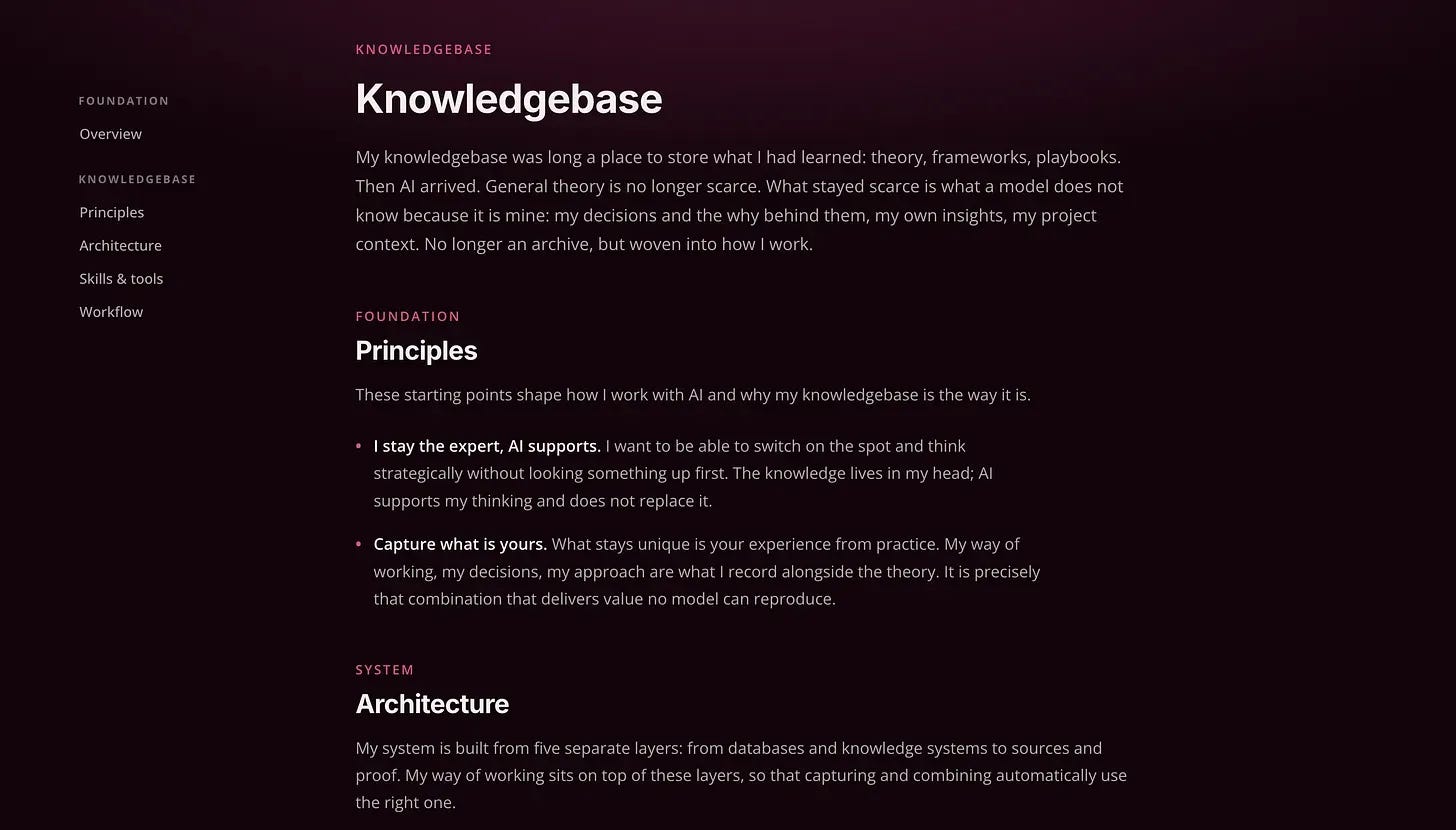
I documented my AI workflow, including my knowledgebase system, in my grimoire, you can find it here.
It describes the principles behind it, the five layers it is built from (knowledgebase, practice and experience, continuous improvement, sources, track record), the skills and tools that run it, and my routines that keeps it alive.